
Pairings with a cigar
There are two main types of pairing in tasting: contrasting pairings and complementary pairings.
- Opposites attract: different flavours are combined to create balance. For example, a cheese can be paired with a sweet white wine to soften its salty or strong character. Similarly, a strong cigar can be paired with a sweet wine to add roundness and balance the intensity.
- Like attracts like: products with similar characteristics are paired to enhance their flavours. Thus, a strong cheese can be enjoyed with a very tannic wine, or a full-bodied cigar with a full-bodied wine to intensify the taste experience.
These two approaches offer different sensations: one seeks balance through contrast, the other harmony through similarity. The choice depends above all on individual preferences.
The agreements
The flavour characteristics of food and drink interact with one another, sometimes significantly altering the perception of tastes and flavours.
For example, a wine tasted with a sweet dessert may seem more acidic than it actually is. Conversely, the same wine served with a dish that is predominantly acidic — such as a vinaigrette salad — may seem sweeter, or even unbalanced. Yet it is strictly the same wine.
When pairing a cigar with a drink – or with food – the key question is therefore this: how do the characteristics of the cigar interact with those of the food or drink?
A successful pairing does not rely solely on complementarity. It can also play on contrast or balance. The aim, however, remains the same: to create harmony on the palate, where no single element overpowers the other.
We speak of a successful pairing only when the tasting experience gains in length, complexity and pleasure, and the whole forms a coherent experience, where each element enhances the other.
The successful agreement
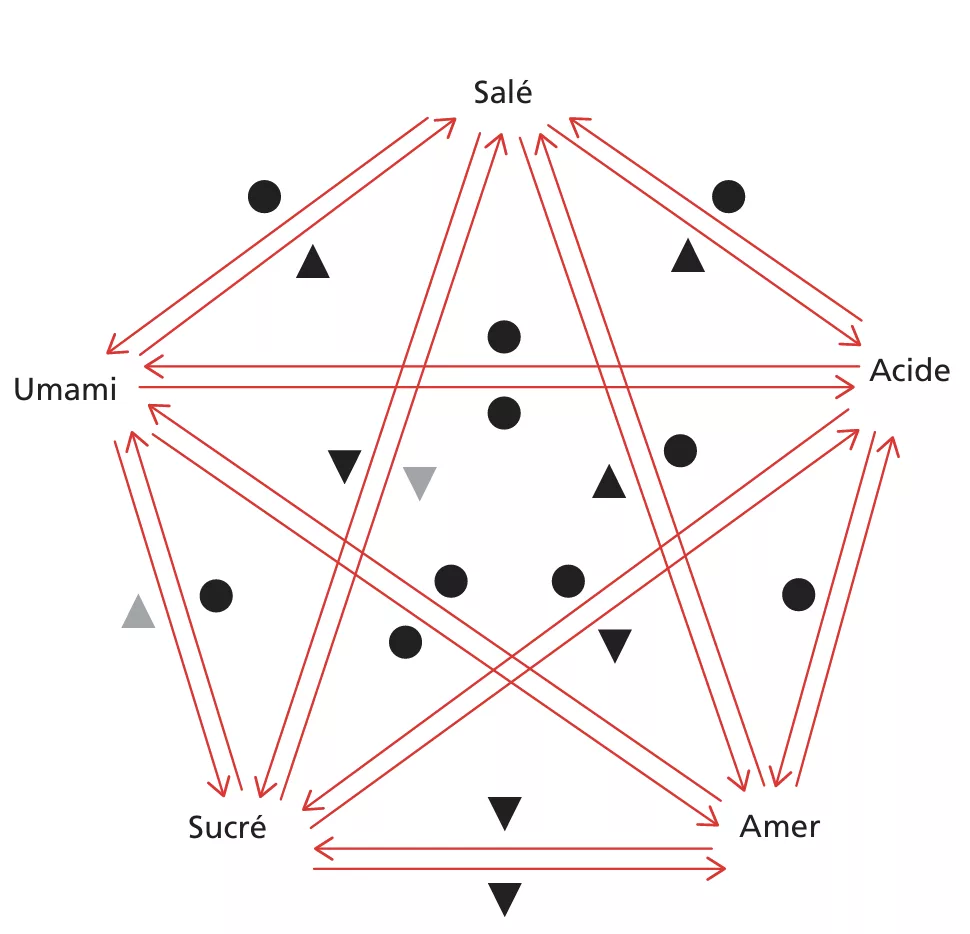
Achieving a successful flavour balance is a complex task, as flavours play a key role in the sensory perception of food. However, they are not perceived in isolation: each flavour quality can alter the intensity or perception of another. The interactions between sweet, salty, bitter, sour and umami thus influence the consumer’s overall taste experience. The study by Mojet et al. (2004) highlights these interaction mechanisms by demonstrating how certain flavours can be enhanced, attenuated or have no effect on one another, depending on the associated aromas. This approach provides a better understanding of the complexity of taste perception and the importance of flavour combinations in food.
The figure illustrates the interactions between different tastes (sweet, salty, sour, bitter, etc.) based on a study by Mojet and his colleagues.
It shows how one flavour can influence the perception of another:
- the outgoing arrows indicate the effect of one flavour on another within the same food;
- the incoming arrows represent the influence of flavours from different foods.
The symbols used specify the type of interaction:
- an upward-pointing triangle means that the flavour is enhanced;
- a downward-pointing triangle indicates that it is weakened;
- a circle means there is no noticeable effect.
Finally:
- the black symbols show that both flavours tested cause the observed effect;
- the grey symbols indicate that only one of the two flavours is responsible for the interaction.
Pairings with a cigar
There are two main types of pairing in tasting: contrasting pairings and complementary pairings.
- Opposites attract: different flavours are combined to create balance. For example, a cheese can be paired with a sweet white wine to soften its salty or strong character. Similarly, a strong cigar can be paired with a sweet wine to add roundness and balance the intensity.
- Like attracts like: products with similar characteristics are paired to enhance their flavours. Thus, a strong cheese can be enjoyed with a very tannic wine, or a full-bodied cigar with a full-bodied wine to intensify the taste experience.
These two approaches offer different sensations: one seeks balance through contrast, the other harmony through similarity. The choice depends above all on individual preferences.