Cigar Journal – A Guide to Tasting
Our main advice is to trust your instincts and let your emotions guide you. All your perceptions will depend first and foremost on your own ‘palate’. You will use your five senses to fully appreciate (or not) every moment of the tasting experience.
Smell accounts for up to 80% of the information perceived when consuming food (Murphy et al. 1977) or a cigar. For example, the smell of hot coffee in the morning that you catch from another room, the aromas of which intensify when you bring it to your lips.
This is why aromas and flavours play a crucial role in tasting, although the other senses should not be overlooked.

The visual appeal of the wrapper’s colour, the texture of its veins or its smooth surface, its colour, its raw draw, the crackling sound of the tobacco as you light it: all five of your senses will be engaged.
In the meantime, immerse yourself in this guide, which is simply designed to help you become more aware of the intuitive stages of tasting using all five senses, whilst keeping one thing in mind: the journey is yours, and you alone are the expert on your own “palate”.
The Palace of the Senses
This concept comes straight from the film… Sherlock Holmes.
Thanks to Benedict Cumberbatch’s talent, Sherlock has brought the detective back into the spotlight, with his famous ‘mind palace’
And more seriously, it is a method that allows us to ‘revisit’ memories we have constructed, by taking a starting point that enables us to reconstruct a moment, a memory, a tasting, an emotion. It is called the ‘Method of Loci’ and was originally used to memorise long lists of ordered items.
Our Blue Smokeuse uses this method daily to memorise tastes, flavours, scents and sensations. She catalogues them in her ‘palace of the senses’. This simple method requires only a little concentration, and a lot of practice (oh dear :-). It can be practised every day, with everything around you. Toast, its smell, its texture, the sensation of hot coffee in the mouth and the bitterness on the gums. It involves regular practice that will make it easier for you to recognise aromas and flavours, and which will allow you to refine… your preferences!

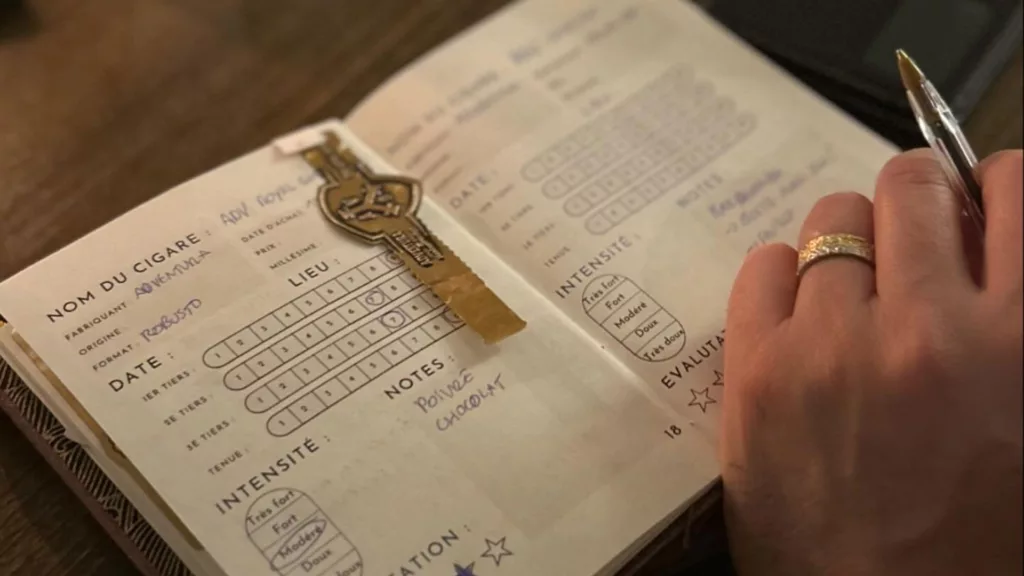
1. First step: note down the context of your tasting
It may seem basic, but it is important to note the context of your tasting: where it took place, the date, and the ‘technical’ aspects of the cigar (origin, size, etc.). This will allow you, when the time comes, to revisit your tasting experience, much like Proust’s madeleine. Very quickly, you will encounter subjective elements, as the ‘momentum’ (the moment when you particularly enjoyed the cigar) or the company you were in will significantly influence your tasting. For example, a Davidoff Signature might taste less pleasant after an argument with your mother-in-law than whilst sitting on a paradise beach in Punta Cana. So make a note of as much information as possible to help you pinpoint the moment in time.
2. The visual
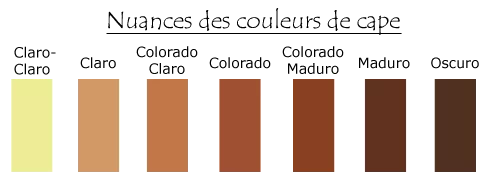
Take a close look at the wrapper. It will reveal two key features: its colour and its texture. Is the wrapper taut? Are the veins visible? Is it smooth, or are there any imperfections? All this visual information will be useful for a first visual assessment of the cigar.
You can also classify its colour, from Claro claro to Oscuro (image source: https://fr.wikipedia.org/wiki/Cigare). And beware of false assumptions: just because a cigar is dark does not mean it is strong, and vice versa! Find out more here.
You can also classify its colour, from Claro claro to Oscuro (image source: https://fr.wikipedia.org/wiki/Cigare). And watch out for false friends: just because a cigar is dark doesn’t mean it’s strong, and vice versa! Find out more here.
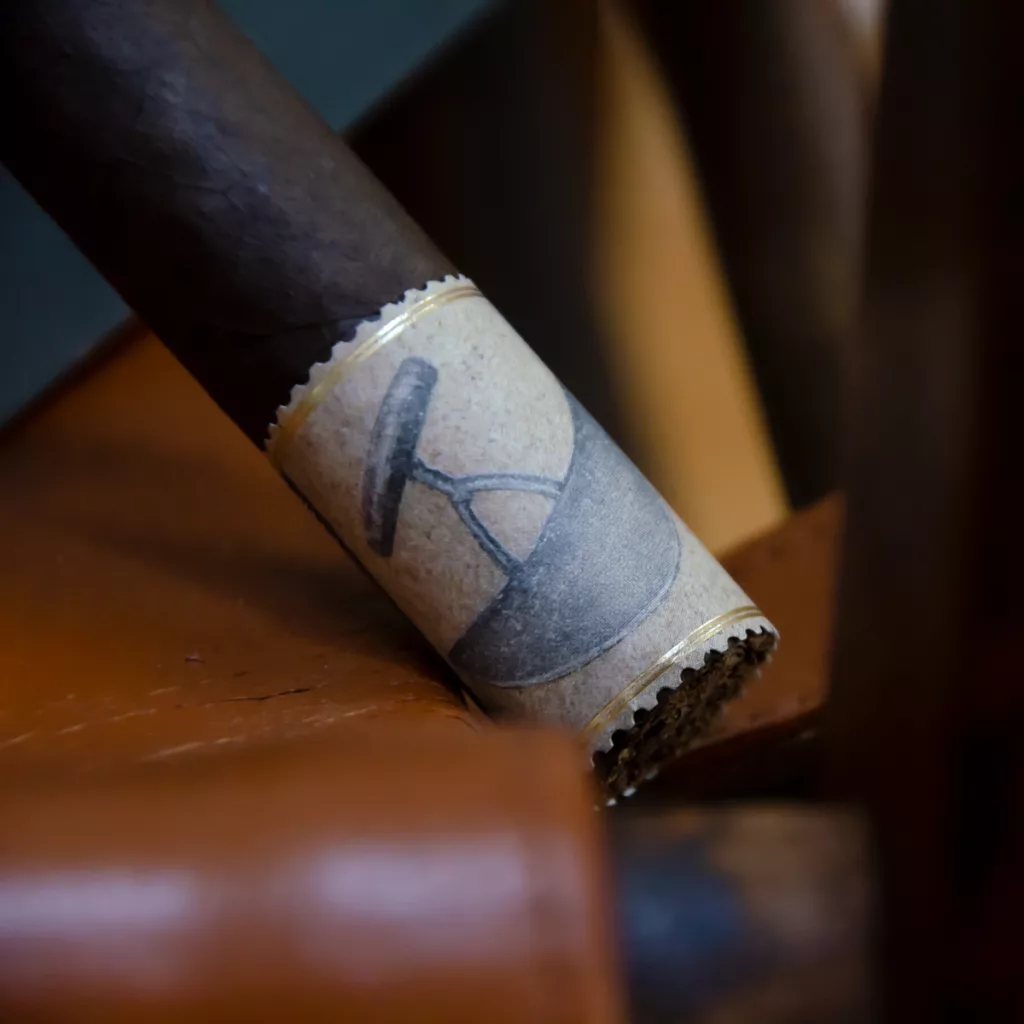
The ring will also be useful, particularly for those who are more visually oriented, as a reminder of a tasting. This in no way detracts from the care and aesthetic appeal that producers bring to the rings, each of which generally tells a story. To give an example, the band of the West Tampa Attic Series #1 proudly features a chaveta – the quintessential symbol of the torcedors and their meticulous work. Its rounded shape allows the wrapper leaves of the cigars to be cut in a single stroke of the blade.
The appearance of your smoke will also be an important part of your tasting experience. Dense, thin, blue, white: take a moment to observe how it behaves.
3. Touch
Let’s move on to the feel. No, you haven’t lit your cigar yet! The wrapper, beneath your fingers, may feel rough, soft or smooth; in short: close your eyes and let your sense of touch detect the subtleties of this examination. An example of an unusual wrapper is the CAO BX3, whose wrapper is pleasantly rough and tells a story all of its own.
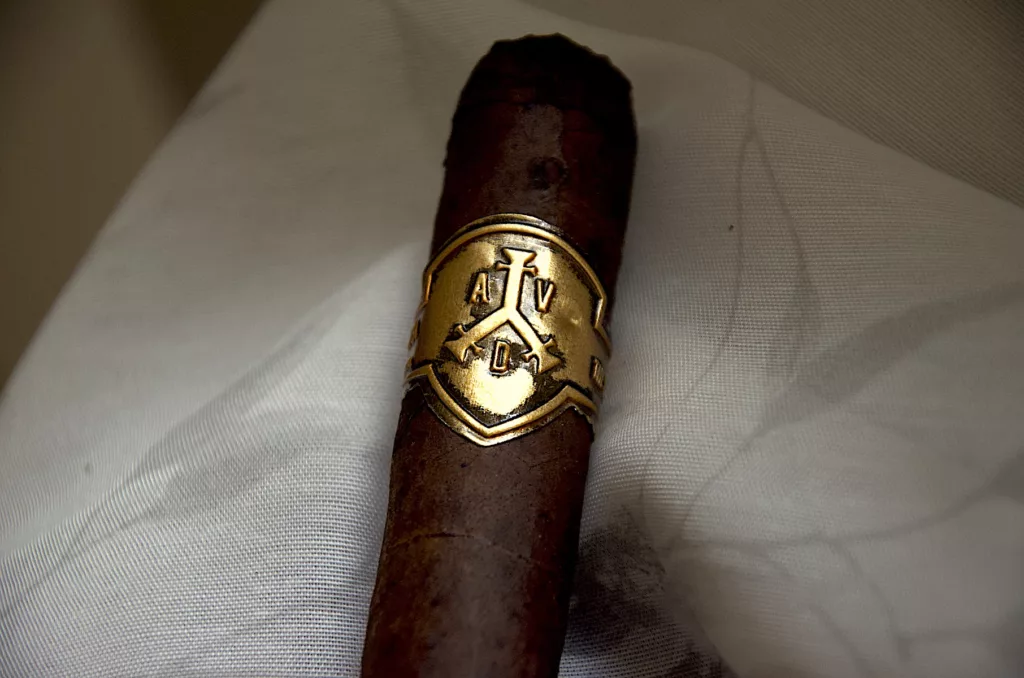
To enhance the experience, run your fingers over the band. The choice of paper is no accident. Some have even taken it a step further by offering embossed metal bands, such as the cigars in the Royal Return range from ADVentura Cigars
Let’s now light this cigar and move on to another essential aspect of the sense of touch: the draw. It is indeed the sense of touch that comes into play here. Tight, loose, pleasant, or sometimes unfortunately blocked, it will be a key element in the enjoyment of the tasting experience.
4. Flavours and aromas
Don’t confuse flavour with intensity – they are two very distinct elements. This is one of the most challenging stages and the one that requires the most practice. You could have fun coming up with fancy words to impress your audience. But let’s take the simplest approach: tune into your palate.
What you smell and feel will almost automatically be linked to a memory. Not necessarily to an actual event (although we think the exercise is easier if that’s the case), but to a familiar flavour. For example, a toasty note will remind you of the smell of toast. A brioche-like note might remind you of the cakes your grandmother used to bake, or simply the pleasant smell of a bakery.
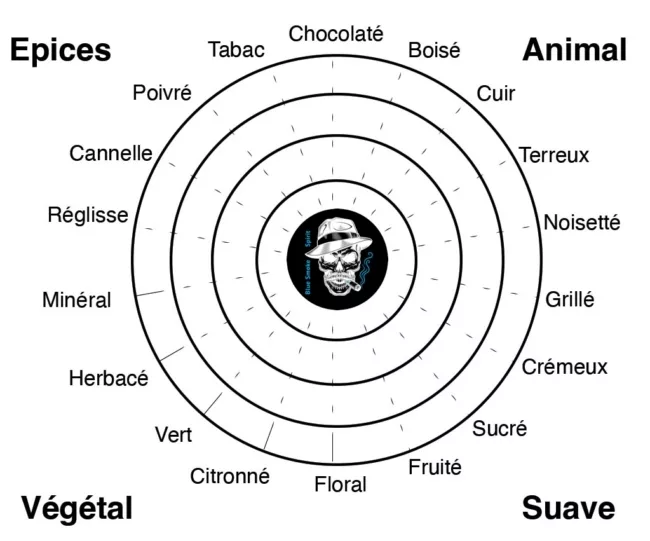
A large number of ‘flavour wheels’ have been created to identify different flavours. We recommend the one from the Confederation’s Agroscope, whose whisky flavour wheel can be used for cigar tasting.
The one we offer is a simplified version, which helps you recognise the main flavour ‘families’. Understanding these aromas will be very useful when pairing your cigar with drinks or food. To learn more about the basics of pairing, read our article on pairings.
5. Power
As for strength, this is determined by the sensation of heat and spiciness that fills your palate. It refers to the cigar’s overall intensity, which encompasses both its physical strength and the impact of its flavours. The strength of a cigar stems mainly from three factors:
The type of tobacco used: Tobacco contains nicotine, and certain varieties of leaf, such as ligeros (leaves from the top of the plant, exposed to the sun), are higher in nicotine. These leaves add strength to the cigar’s blend.
Ageing and fermentation: The processing of tobacco plays a crucial role. The more the tobacco is fermented and aged, the more the flavours can develop, but this can also soften or intensify the strength, depending on the process.
Blending: The combination of different parts of the plant (the ligero, seco and volado) affects the strength. Cigars made from stronger leaves will be more intense.