Basic principles of sensory analysis
Flint, forest floor, vetiver… these are all terms that can quickly be confusing. When an amateur finds themselves in the company of fragrance experts, they can soon feel lost in a jungle of technical jargon.
But when it comes down to it, isn’t tasting ultimately all about emotions? Let’s get back to basics.
Human beings are endowed with five senses, which enable them to analyse the world around them and navigate it. We observe, smell, listen, touch… and, of course, we taste. These mechanisms are universal: everyone therefore has the tools needed to conduct a tasting independently.
A simple rule applies here: there is no right or wrong. It is not just a matter of analysing a product from a technical perspective, but also of understanding how it is perceived through our own senses and sensibilities.
A personal tasting experience above all
In our view, tasting — whether of wine, fine food or cigars — is above all a matter of common sense and our ability to link sensations and emotions.
With practice, everyone gradually develops a true sensory memory, a sort of ‘palate of flavours’.
We live within our own bodies, with our memories, our emotions, our points of reference. Everyone thus possesses their own sensory universe — a palate of which they are the sole master.
The aim is therefore simple: to learn to trust oneself and to rely on one’s five senses to enjoy a personal experience.
The image
Even before we taste it, we observe it. Our brain is already analysing it and forming expectations based on our past experiences.
In the case of a cigar: What is the colour of the wrapper? Is it oily or dry? Does it have veins? Be careful, however, not to jump to conclusions. A dark colour does not necessarily imply a strong strength. Similarly, a light wrapper can reveal intense, spicy notes. The same applies to the band, which is often designed to subconsciously influence your perception.
The aim here is simple: observe without preconceptions, and describe what you see before interpreting it.
The taste
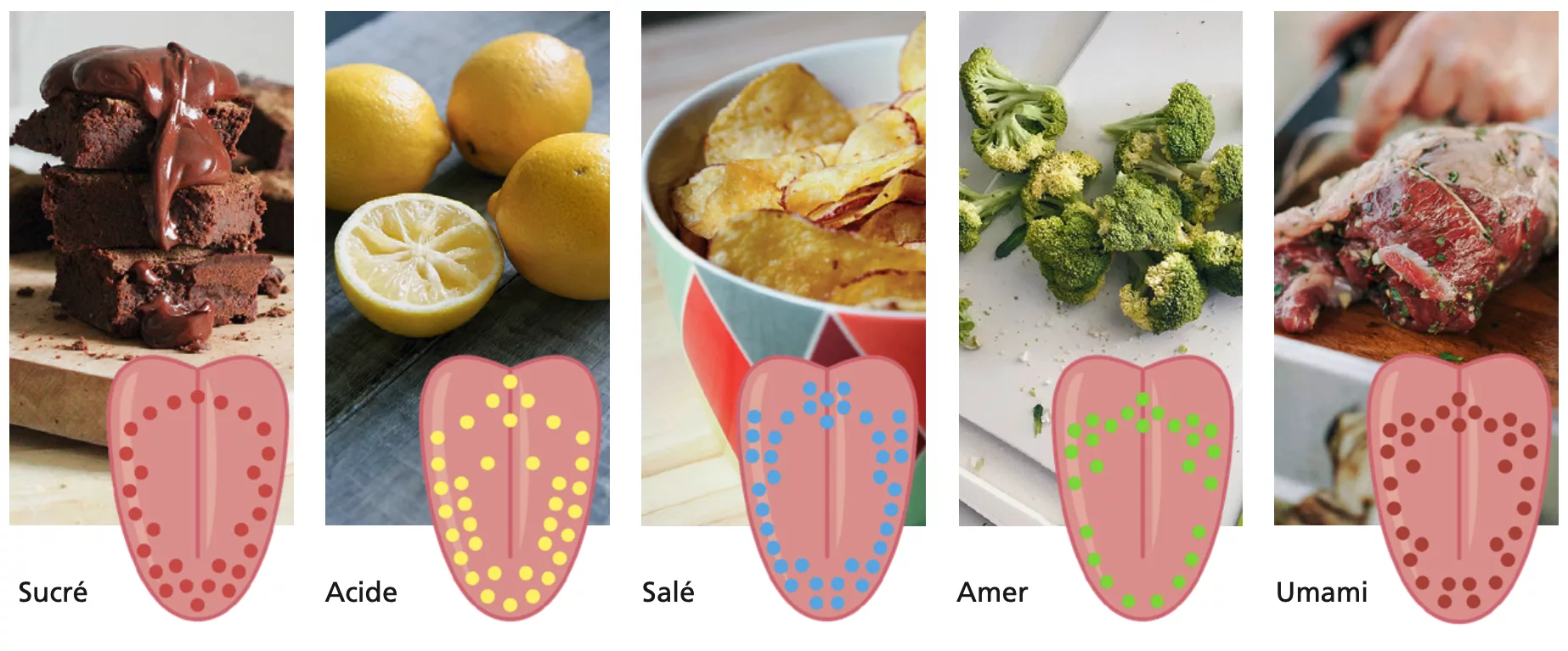
Taste perception varies greatly from one person to another, making it a deeply personal sense.
Whilst certain basic tastes are universal (sweet, salty, sour, bitter), more complex nuances depend largely on our individual sensibilities and experiences. The same applies to flavour pairings. Some will enhance a product, whilst others will, on the contrary, tone down certain flavours.
When pairing a cigar with a drink — or a cigar with food — it is essential to consider how they interact: whether
they complement, contrast or balance each other. A successful pairing is characterised by its lingering finish and the harmony it creates, where each element enhances the other without overpowering it.
The sense of smell
Smell plays a central role in tasting, accounting for up to 80% of the information perceived.
Aromas can be perceived in two ways:
- orthonasal (through the nose)
- retronasally (via the palate)
But beyond the technical aspects, the sense of smell is above all closely linked to memory and emotions.
This is the famous Proustian madeleine phenomenon: a scent or flavour can instantly bring back a buried memory.
So, during a tasting, let these associations emerge. A scent is not just a descriptive note — it is often a gateway to a personal experience.
The more consciously you practise this exercise, the more precise your olfactory identification becomes.
Touch
Touch is often underestimated, yet it plays a vital role. Using your fingers, you can assess the cigar’s texture: suppleness, veins, and the quality of the wrapper. On the palate, it is expressed through the density of the smoke, the texture and the thermal sensation. The heat of the cigar, the sensation on the palate or at the fingertips are all clues that enrich the experience.
Hearing… and, above all, the feeling
Finally, there is one factor that is often overlooked: your overall impression.
Beyond analysis, tasting is, above all, a personal experience.
The ultimate criterion remains simple: enjoyment.
It is this that gives meaning to everything else.